Up 22.2% on the IPO price: how secondary trading in UzNIF shares began
Kursiv Uzbekistan spoke with experts about the placement and the outlook for the shares
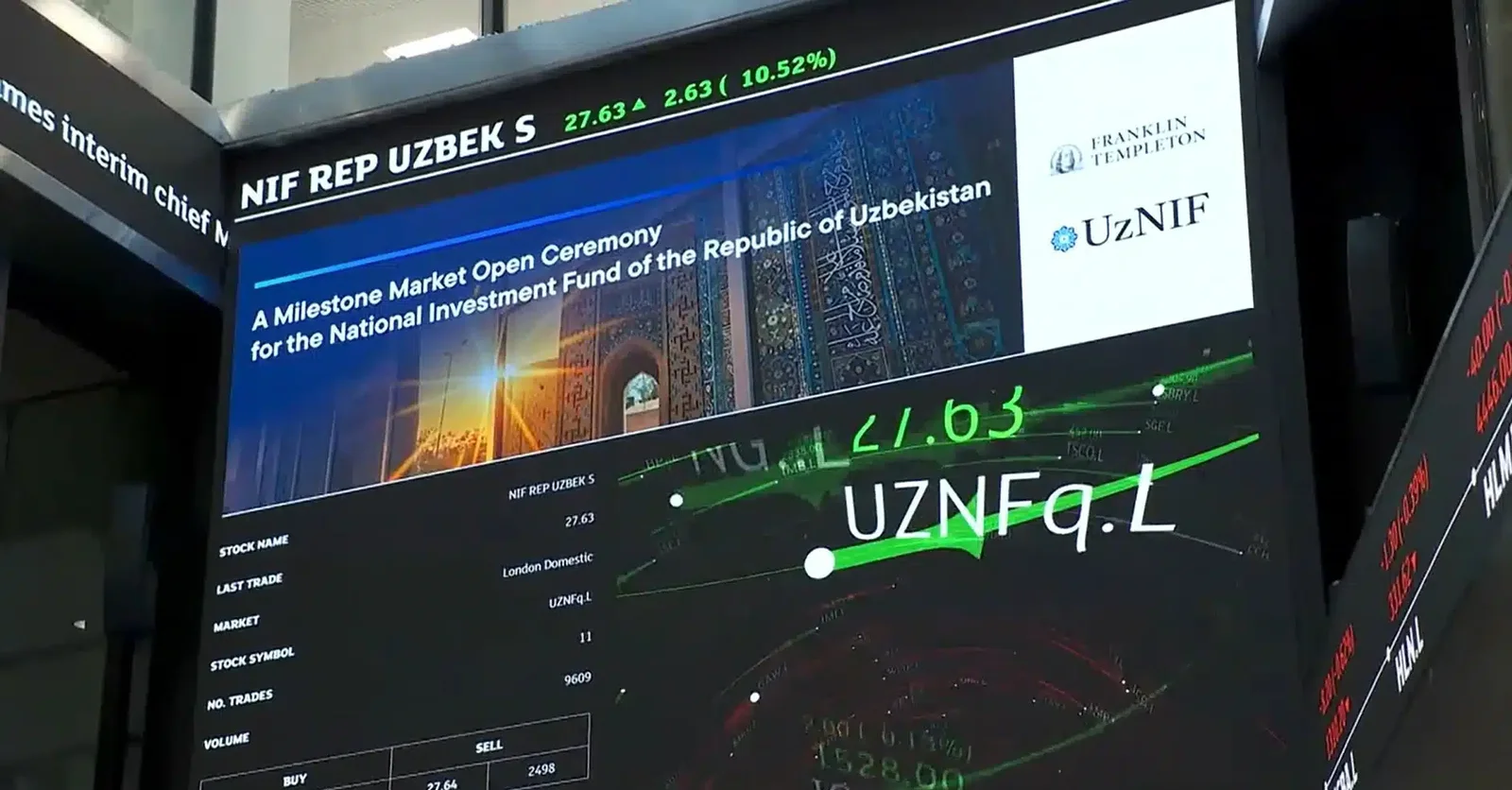
Secondary trading in UzNIF shares has begun / LSE
The opening price of shares of Uzbekistan’s National Investment Fund (UzNIF) was 22.2% above the placement price for retail investors in the IPO in Uzbekistan. The first trade on 18 May was at UZS 5.39, while the shares had been placed at UZS 4.41, according to the Tashkent Stock Exchange. By 12:24 Tashkent time on 18 May the shares were already up 37.6%. Unconditional trading also began in London, with Saida Mirziyoyeva, head of the Presidential Administration of Uzbekistan, taking part in the launch ceremony. Kursiv Uzbekistan spoke with experts about the investor mix in the local market and the outlook for the shares.
Contents:
- Global excitement and local priority
- Institutional investors hold back
- Investor profile: young and deliberate
- Secondary market: speculation or long term
- Forecasts and expectations
UzNIF became the first Uzbek company with a dual listing. The participation of global giants such as BlackRock and Franklin Resources, as well as a placement size unprecedented for the local market, set a new bar for expectations. However, behind the striking figures of international expansion lie complex mechanics of demand allocation and the specific behaviour of different investor groups within the country.
The underwriters of the placement were Avesta Investment Group, Bluestone Financial Group and Alkes Research. The technological bridge for individuals was provided by the Jett app, through which most retail orders were submitted.
Global excitement and local priority
The main indicator of any IPO’s success is the oversubscription ratio. In UzNIF’s case, interest exceeded supply many times over, as all participants confirm.
“Globally, the offering was more than four times oversubscribed,” says Dimitriy Abbasov, director of Avesta Investment Group. According to him, the main source of this demand was foreign investors, whose interest in Uzbekistan in general and the fund in particular proved extremely high. “In the London tranche investors received an allocation of about 25% of their orders, which reflects the scale of demand,” the expert adds.
Odil Musaev, managing director of Alkes Research, confirms this: “The UzNIF IPO was more than four times oversubscribed, reflecting high interest from both international and local investors.” He stresses that about 47.94 billion shares worth around $17.7 million were allocated in the Tashkent offering, making it the largest placement in the history of the local stock market.
An important feature was the share allocation strategy. To support the domestic market, the state deliberately made concessions in favour of citizens. As Dimitriy Abbasov notes, by decision of the Ministry of Economy and Finance all private investors on the local market received a 100% allocation. “This was a deliberate decision to support retail demand on the local market. With this approach, the question of insufficient volume for retail simply did not arise,” the Avesta Investment Group director explains.
Tolibjon Mirzakulov, head of the Jett service, develops the same idea: “Retail investors with fully funded orders received their full allocation — 100% — at a preferential price of UZS 4.41 per share (a 5% discount to the offer price). This is rare in capital markets, and it speaks for itself: the state wanted citizens to have priority in this IPO.”
Institutional investors hold back
Despite the overall success, the participation of large domestic players — banks, insurers and pension funds — was restrained. Experts admit that local institutional capital is not yet ready to use its full potential.
Dimitriy Abbasov said: “Demand from institutional investors was restrained — banks face regulatory limits on equity investments and reserve requirements, and other corporate investors are generally not yet ready to work with this asset class.” As a result, local institutions were allocated just over 55%, Abbasov sums up, adding that the participation of certain players can be seen as a positive signal.
Odil Musaev is more reserved on this point, citing confidentiality: “We saw interest from various categories of local institutional investors, some of whom have already publicly announced their participation in the IPO. However, the structure and composition of investors are confidential.”
Nevertheless, the lack of broad interest from the market’s heavyweights did not surprise the professional community. Farrukh Khodjaev, director of Kapital Depozit, believes the market is still taking shape. “We have not yet seen hype or aggressive demand on the local market. But the very fact that more than UZS 200 billion was raised locally without large-scale marketing says a lot. For Uzbekistan’s young stock market, UzNIF’s current result is already a very serious step forward,” he notes.
Investor profile: young and deliberate
With little activity from institutions, retail played first fiddle in the local tranche. Digitalisation made it possible to attract an audience that had previously ignored traditional exchange instruments. According to Tolibjon Mirzakulov, most of the local retail tranche went through Jett, and the average ticket rose about fivefold compared with previous placements.
“The average ticket in previous IPOs was about one million sums. This time the average participant invested an amount comparable to their monthly salary (about UZS 6.83 million),” the Jett founder shares. He highlights a qualitative shift in behaviour: “Many investors first submitted an order for a small amount, and then — after studying the fund’s parameters, its portfolio of 13 companies and dividend policy — cancelled it and submitted a new, much larger one. People did not act impulsively.”
The demographic breakdown is also impressive. More than 62% of IPO participants are under 35. “The most active group was investors aged 25–34 — about 40% of the whole pool. This is a generation that already has an income and has mastered digital financial services,” Mirzakulov notes. The geography of orders also widened, turning the IPO from a ‘capital-city story’ into a national event.
“At some point, because of the huge influx of private investors, there were concerns that members of the local underwriting consortium might have difficulty entering all orders into the exchange system on time. But the team did an excellent job — all orders were entered and filled in full,” said Dimitriy Abbasov.
Age distribution of participants via Jett
Age group — Share
18–24 — 22.7%
25–34 — 39.7%
35–44 — 26.0%
45–54 — 9.1%
55–64 — 1.8%
65 and over — 0.7%
Total — 100.0%
Secondary market: speculation or long term
Dimitriy Abbasov explains the absence of broad presentations for retail during the subscription period by legal restrictions: “A broad marketing campaign was launched after the order book opened — this is due to requirements protecting retail investors from aggressive advertising of high-risk instruments.”
Farrukh Khodjaev of Kapital Depozit divides investors into two groups: “The first sees UzNIF as a long-term investment and came in at a 5% discount. The second group indeed took a wait-and-see position, hoping for a more attractive price on the secondary market on 18 May. That is normal market logic.”
Interestingly, investors were prepared to rebalance their portfolios to take part in UzNIF. “There was a certain shift of liquidity. On the last day alone, investors withdrew several billion sums through our app to take part in the IPO. We saw some investors reduce positions in bank shares and URTS,” says Khodjaev. In his view, this is a sign the market is maturing: investors are starting to actively manoeuvre between different assets.
Odil Musaev adds that the fund’s long-term story depends on fundamentals: “It is linked to ongoing reforms, the transformation of portfolio companies and potential future IPOs within the fund’s portfolio.”
Forecasts and expectations
The question of upside remains debatable, as professional participants avoid direct price forecasts but point to objective drivers.
“We believe the outlook for UzNIF’s share price is directly linked to the growth prospects of Uzbekistan’s economy as a whole and the professionalism of the asset manager, Franklin Templeton,” says Dimitriy Abbasov. His company plans to provide research coverage of the stock, which should make the asset more transparent for individuals.
Tolibjon Mirzakulov also bets on fundamentals and names: “The fund is managed by Franklin Templeton, a company with $1.74 trillion in assets. The anchor investors — BlackRock, Franklin Resources, Redwheel — are top-tier global names. Their $300 million participation is a vote of confidence.” He also recalls the guaranteed dividend policy: under a presidential decree, portfolio companies must pay out at least 50% of profit as dividends until 2030.
Concluding, Farrukh Khodjaev stresses the instrument’s significance for infrastructure: “I see UzNIF not as a short-term speculation but as an infrastructure investment in Uzbekistan’s economy. The fund effectively gives investors access to a large pool of the biggest Uzbek companies through a single instrument. We will advise long-term investors to add to their positions on a correction rather than exit.”
Kursiv Uzbekistan previously reported that the total raised in the IPO was approximately $604 million. It is important to note that the company itself did not receive money from the sale — all proceeds go to the shareholder (the state). The fund’s market capitalisation at the time of placement was estimated at $1.95 billion. Uzbekistan’s Ministry of Economy and Finance sold 31% of the capital. The offer price was $25.00 per GDR in London and UZS 4.65 per share in Tashkent (UZS 4.41 with the 5% discount for resident individuals on orders of up to UZS 12 billion).
Source: Kursiv Uzbekistan