Uzbek equities to watch: analysts’ views for 2025
As of 15 August 2025, 100 companies are listed on the Tashkent Stock Exchange. Not all of these issuers’ shares and bonds have growth potential. Uzbekistan’s stock market is still characterised by low liquidity and a limited number of research reports. Against this background, it is especially important for investors to understand which shares may be undervalued and which are overvalued relative to their fundamentals. Kursiv Uzbekistan discussed this with experts.

Photo: Pexels.com
Undervalued stocks
Farrukh Khodjaev, director of the investment company Kapital-Depozit, notes that particular attention should be paid to certain bank shares and industrial stocks.
“In particular, I consider Hamkorbank (P/B = 0.61, ROE = 26.2%), Uzpromstroybank (P/B = 0.21, ROE = 12.4%) and Uzmetkombinat (P/B = 0.41 with moderate EPS) undervalued. The banks have a P/B well below one with a positive ROE, which points to a potential undervaluation of their book value and profitability,” Khodjaev said.
Shodlik Nazarov, director of Avesta Investment Group, takes a similar position. According to him, Hamkorbank shares, quoted at around UZS 30 apiece, can be considered undervalued.
“The bank shows steady growth of 18–20% a year and has one of the lowest NPL ratios — about 1.5% versus a national average of 3.8%,” he stressed.
The experts disagreed on the Uzbek Republican Commodity Exchange (UzRTSB): Shodlik Nazarov considers the stock undervalued, while Farrukh Khodjaev considers it overvalued.
“UzRTSB ordinary shares trade at UZS 4,290–4,300 per share. The company is one of the most transparent and steadily growing in the country, showing annual growth of 20–40%. At current prices the trailing P/E is about 4.6,” said Shodlik Nazarov.
Farrukh Khodjaev drew attention to the high P/B ratio (3.31). In his view, the shares trade at a premium to their fundamentals. At the same time, he noted that the company shows stable profitability and pays dividends regularly, which partly justifies the high market valuation. Meanwhile, limited scalability of the business and low market liquidity are holding back further price growth.
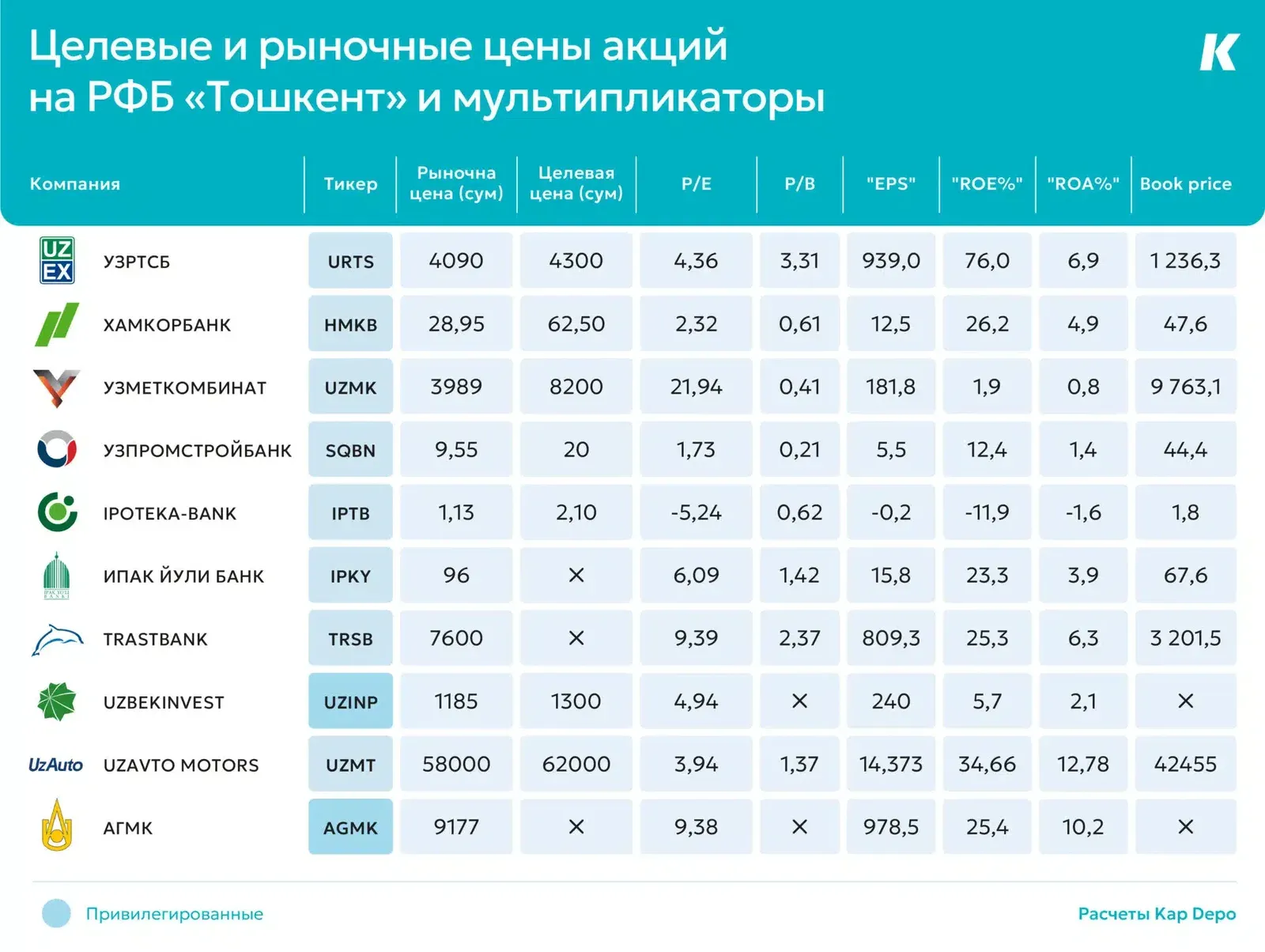
Target and market prices of shares on the Tashkent Stock Exchange and multiples. KAP DEPO calculations
Overvalued issuers
According to Khodjaev, the preferred shares of Almalyk MMC (AMMC) and Trastbank stock also look overheated.
“AMMC preferred shares look relatively expensive against their par value: at a price of about UZS 9,000 they pay a fixed dividend of 25% of par (UZS 3,914), giving a yield of 10.8%,” Khodjaev comments.
According to him, the main interest in these shares is supported by expectations that profits may be capitalised into the charter capital, potentially leading to an issue of additional bonus shares. Nevertheless, the current price already includes a significant premium for these expectations, which makes the asset vulnerable to a revaluation. The inflated valuation is also explained by the issuer’s high profile and a shortage of supply, which may distort its objective market value.
Trastbank’s multiples are P/E = 9.39 and P/B = 2.37. Farrukh Khodjaev believes this is a high P/B for a bank. The book price is UZS 3,201 and the market price UZS 7,600 — almost 2.4 times higher. Although an ROE of 25.3% can be considered decent, even taking this into account the shares trade at high multiples. The expert believes the current price may have been shaped by speculative demand and excessive expectations not backed by specific corporate events.
Shodlik Nazarov adds that Kvarts, Kyzylkumcement and UzAuto Motors can also be considered overvalued. The cement industry has serious overcapacity, which hurts prices and company profits. At UzAuto Motors, according to him, margins and overall profit are declining amid increased competition, falling sales and tighter car lending.
Reasons for low valuations
Farrukh Khodjaev believes that the main reason a number of shares in Uzbekistan are undervalued remains the structural features of the market:
- limited liquidity and low free float in most stocks;
- weak dividend policy (especially at banks, where profit is mainly retained to build capital rather than paid out as dividends);
- low analytical coverage by professional participants;
- limited interest from institutional investors, both domestic and foreign.
An additional constraint is investors’ persistent distrust of the quality of disclosure and corporate governance. The absence of independent credit and investment ratings also affects risk perception and holds back the revaluation of companies.
The expert believes the situation could be changed by growing interest from international investors, the introduction of predictable dividend policies and better corporate governance.
“The general reasons for overvaluation on the Uzbek stock market largely stem from low liquidity, limited analytical coverage and a lack of market depth. Even moderate demand from retail investors can lead to a significant shift in prices without fundamental justification. Therefore, analysis should pay close attention to multiples, the stability of the business model and the issuer’s dividend profile,” summed up Farrukh Khodjaev.
Kursiv Uzbekistan previously wrote about more than ten mistakes investors make at the start of their journey. One of them is investing without prior calculations, for example without considering ROA and other fundamentals. It is also important to remember that investing always carries the risk of losing money — due to falling prices, a company default or other reasons.
Source: Kursiv Uzbekistan