Markets wobble, Trump threatens: is there a window for Uzbekistan’s Eurobonds?
April and May 2025 brought noticeable volatility to the emerging-market Eurobond market. Investors faced many factors affecting yields and prices — from tariff announcements to expectations about the Fed rate. Kursiv Uzbekistan spoke with experts about the current market situation and how realistic it is for Uzbekistan to place new sovereign Eurobonds in these conditions.

NewAfrica / depositphotos.com
April–May turbulence
According to Farrukh Khodjaev, director of the investment company Kapital-Depozit, “the emerging-market Eurobond market went through a phase of heightened volatility in April–May amid foreign-policy risks and a repricing of global interest-rate expectations”. He believes that the cost of borrowing for issuers such as Uzbekistan is driven primarily by “the dynamics of US Treasury yields, Fed policy and global risk appetite”.
In his view, what matters to investors is “not only macroeconomic stability, but also the transparency of fiscal policy, the trajectory of public debt and the state’s ability to maintain fiscal discipline”.
In this respect, he believes, Uzbekistan is showing “positive shifts”, which supports interest in its bonds despite market turbulence.
Price of sovereign Eurobonds as a percentage of par in 2025
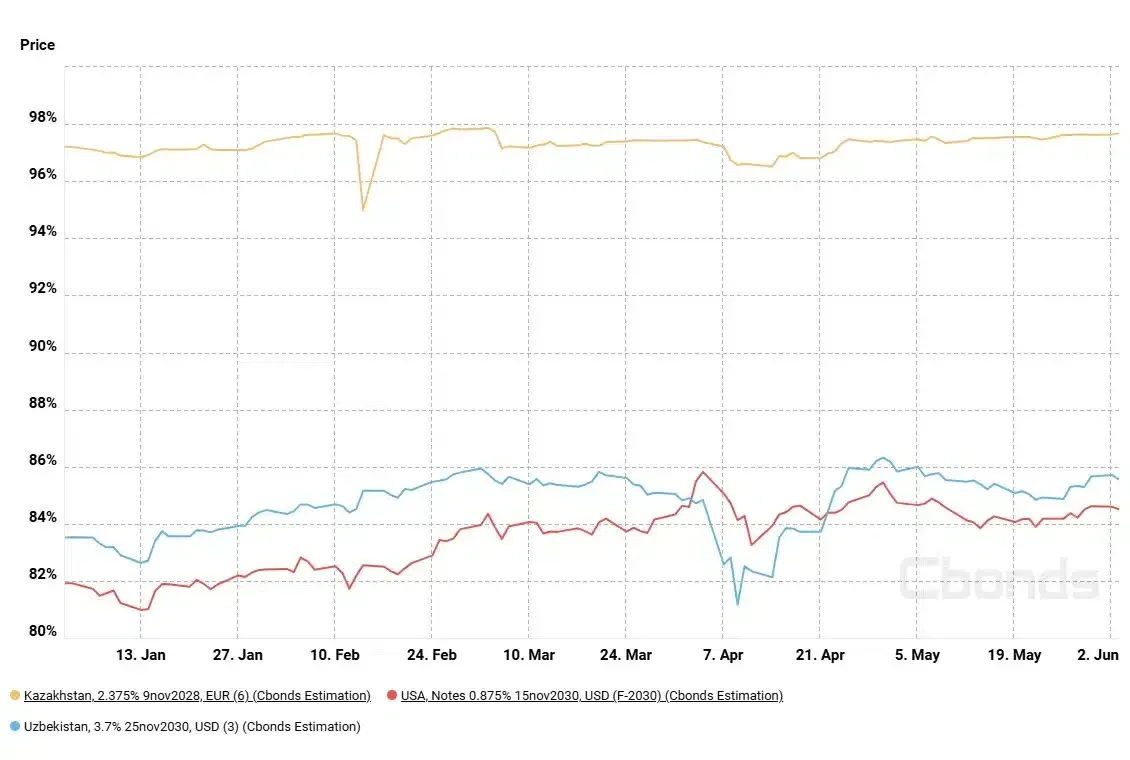
A sharp price drop in the first half of April. Source: Cbonds
Shodlik Nazarov, senior financial analyst at Avesta Investment Group, confirms that from April to May the market went through “volatility and sell-offs”, caused primarily by “Donald Trump’s statements about new trade tariffs on China, Mexico, Canada and later Europe”. He notes that yields on Uzbekistan’s bonds “exceeded 8%, and the spread to Treasuries reached 436 basis points”.
“This shows that investors still see the country as a risky borrower. Despite the high coupon yield, Uzbekistan’s bonds are perceived as volatile and less reliable,” the expert stressed.
Rising yields, and therefore falling prices, were seen not only in sovereign but also in corporate bonds. For example, since their placement last year, Navoi MMC bonds had mostly traded above par. However, a sharp drop occurred in the first half of April 2025.
Change in the price of the Navoi MMC bond as a percentage of par
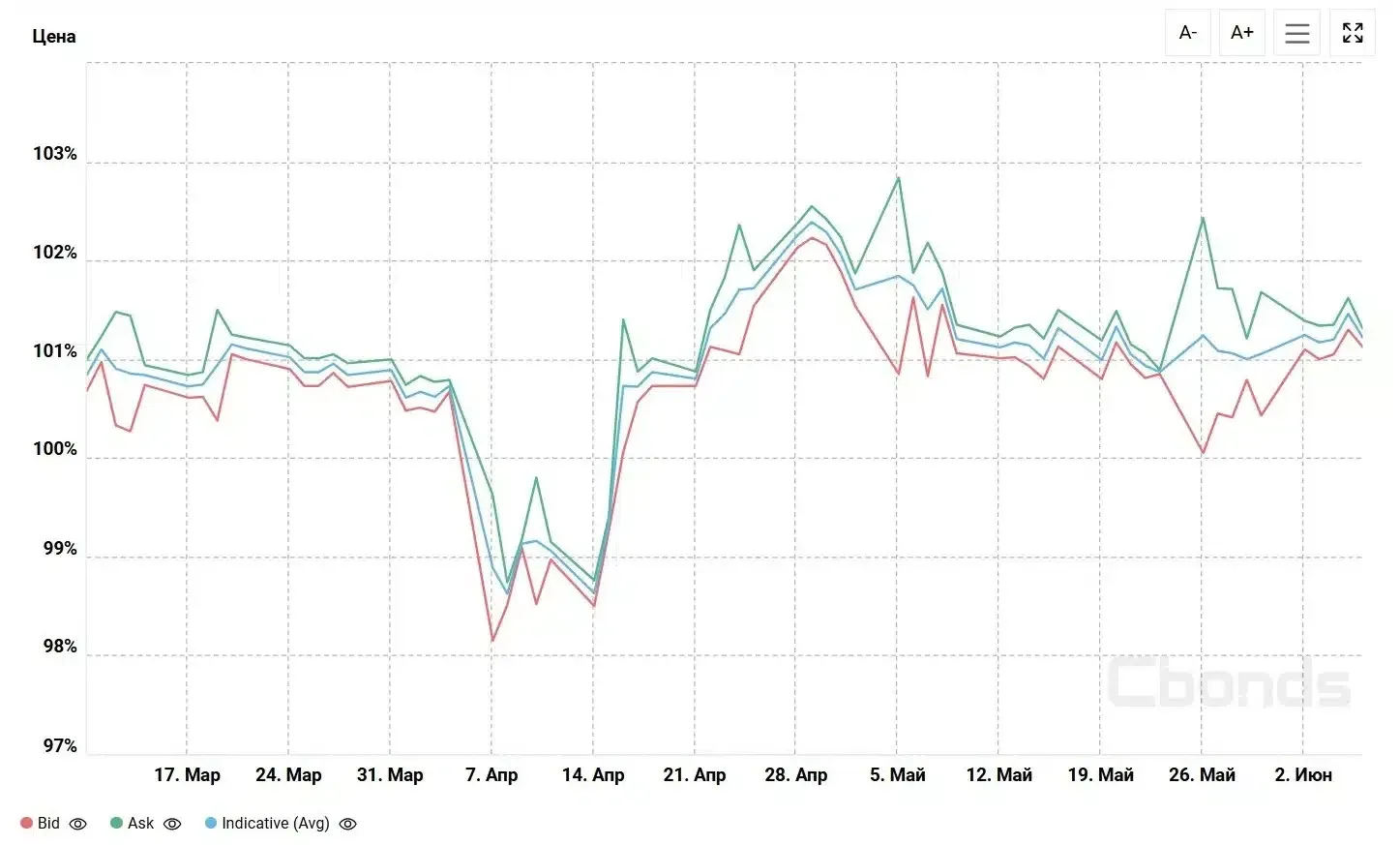
The chart shows the price drop in the first half of April. Source: Cbonds
Drivers: not only Trump
Commenting on the events of early April, Farrukh Khodjaev stresses that “the market reacted not only to Donald Trump’s rhetoric”. According to him, “tariffs were a significant factor”, but “changes in interest-rate expectations, possible trade barriers, economic growth forecasts and global events” also played a role. In addition, “strong macroeconomic data in the US” also contributed to rising yields.
Shodlik Nazarov shares this view. He points out that “the main and most resonant event was indeed Trump’s tariff announcement”, but “the sharp move in the Eurobond market was not caused by a single factor”. Among other reasons he cites “strong labour market data”, “low unemployment” and “a higher-than-expected services PMI”.
“All this suggested that the US economy was still far from slowing down, which means rates could stay high for longer,” Nazarov emphasises.
May: hopes on rates and fears of trade wars
According to Khodjaev, May was “dominated by expectations about the Fed rate”, but “geopolitics and uncertainty about China’s economy” also played a significant role, especially for “higher-risk securities”. He notes that US–China trade tensions, as well as uncertainty about China’s economic outlook and its potential impact on emerging markets, contributed to volatility.
“As for emerging markets, the focus remains on debt sustainability, currency stability and growth rates. Countries that demonstrate realistic fiscal policy and institutional reforms keep their chances of attracting global investors even in a turbulent environment,” Khodjaev stresses.
Nazarov also calls May “a month of uncertainty and mixed signals”. Rate expectations prevailed in the first half of the month, but “in mid-month a wave of alarming news hit the market again”. In particular, he mentions “plans to introduce new tariffs from 1 June — 50% on EU goods and 25% on smartphones”, which signalled a further escalation of trade risks.
“These actions raised fears that the global economy could slow again and the Fed would find itself in a more difficult position: inflationary pressure on one side and weak global trade on the other. As a result, investors became more cautious in the last ten days of May. UST yields rose again, and interest in riskier assets, including emerging-market Eurobonds, declined,” comments the Avesta Investment Group representative.
Uzbekistan is in no hurry
Despite the instability, both experts believe Uzbekistan can place Eurobonds in 2025, provided it prepares well and chooses the right timing.
Farrukh Khodjaev says: “The probability of a successful placement remains high, especially if it is well prepared.” He stresses that “Uzbekistan has established itself as a reliable borrower with a moderate level of public debt”. However, given current global risks, the market will demand higher yields.
“But with careful preparation, the use of ESG labels and structuring the issue to suit different investor groups, Uzbekistan can place its bonds on reasonable terms,” the expert believes.
Shodlik Nazarov also considers a placement realistic, but warns that the main risk lies not in the placement itself but in how expensive the borrowing will be. He points to current yields on Uzbekistan’s bonds (6.5–7.5%) and a G-spread of 250–350 bps, significantly higher than for comparable countries such as Kazakhstan (100–140 bps).
“Such a premium means the market demands additional compensation for country risk, weak liquidity and an unstable external environment. If the government decides to come to the market in the coming months, the borrowing will almost certainly be expensive,” the expert stresses.
He suggests that it would most likely be a relatively small issue without active marketing. Historically, investors have been willing to buy sovereign bonds even amid high uncertainty, especially if there is market novelty or an attractive yield. With its low public debt and stable macro indicators, Uzbekistan may still look interesting.
“It is important to understand that Uzbekistan is not in urgent need of raising foreign-currency liquidity. Gold and foreign exchange reserves cover about ten months of imports, and budget needs are partly met through domestic issues and loans from international institutions. This gives freedom in choosing when to come to the market — and if global conditions (for example, Fed policy) improve by autumn, the chances of a successful and relatively cheap placement will increase,” concluded Shodlik Nazarov.
Recall that in February this year Uzbekistan placed sovereign Eurobonds. The bonds were issued in three currencies: $500 million, €500 million and UZS 6 trillion. The proceeds were used to cover the state budget deficit, develop housing programmes and mortgage lending, and finance green projects.
Source: Kursiv Uzbekistan