Dollars at 11.5%: which bonds offer the highest yield in Uzbekistan’s market
Kursiv Uzbekistan discussed the outlook for Agat Credit’s issue with the issuer, the underwriter and an independent expert
Photo: depositphotos.com
Uzbekistan has already registered four issues of dollar-denominated corporate bonds totalling $90 million. The latest is Agat Credit’s $10 million issue: the company offers investors 11.5% per annum — the highest coupon on the new market. Kursiv Uzbekistan discussed the prospects and risks of the new instrument with the issuer, the underwriter and an independent expert.
The new market has already reached $90 million
The ability to issue corporate bonds denominated in foreign currency appeared in Uzbekistan under the special legal regime of the regulatory sandbox.
The National Agency for Prospective Projects (NAPP) registered the first foreign-currency corporate issue on 10 September 2026 for Asia Alliance Bank — $20 million. Within the next two weeks the number of bonds reached four, with a combined volume of $90 million.
The largest belongs to Uzum — $50 million, or 55.6% of the total. Next comes Asia Alliance Bank. Universal Bank and Agat Credit each issued $10 million.
The terms differ not only in size. Asia Alliance Bank offers a 7% coupon for three years, Universal Bank 8.5% for two years, Uzum 8.5%, and Agat Credit 11.5% for two years. So the coupon range on the new market is already 7–11.5% per annum.
Poytaxt Bank is preparing another $10 million issue. If it is registered, the combined volume of registered and planned dollar placements will reach $100 million.
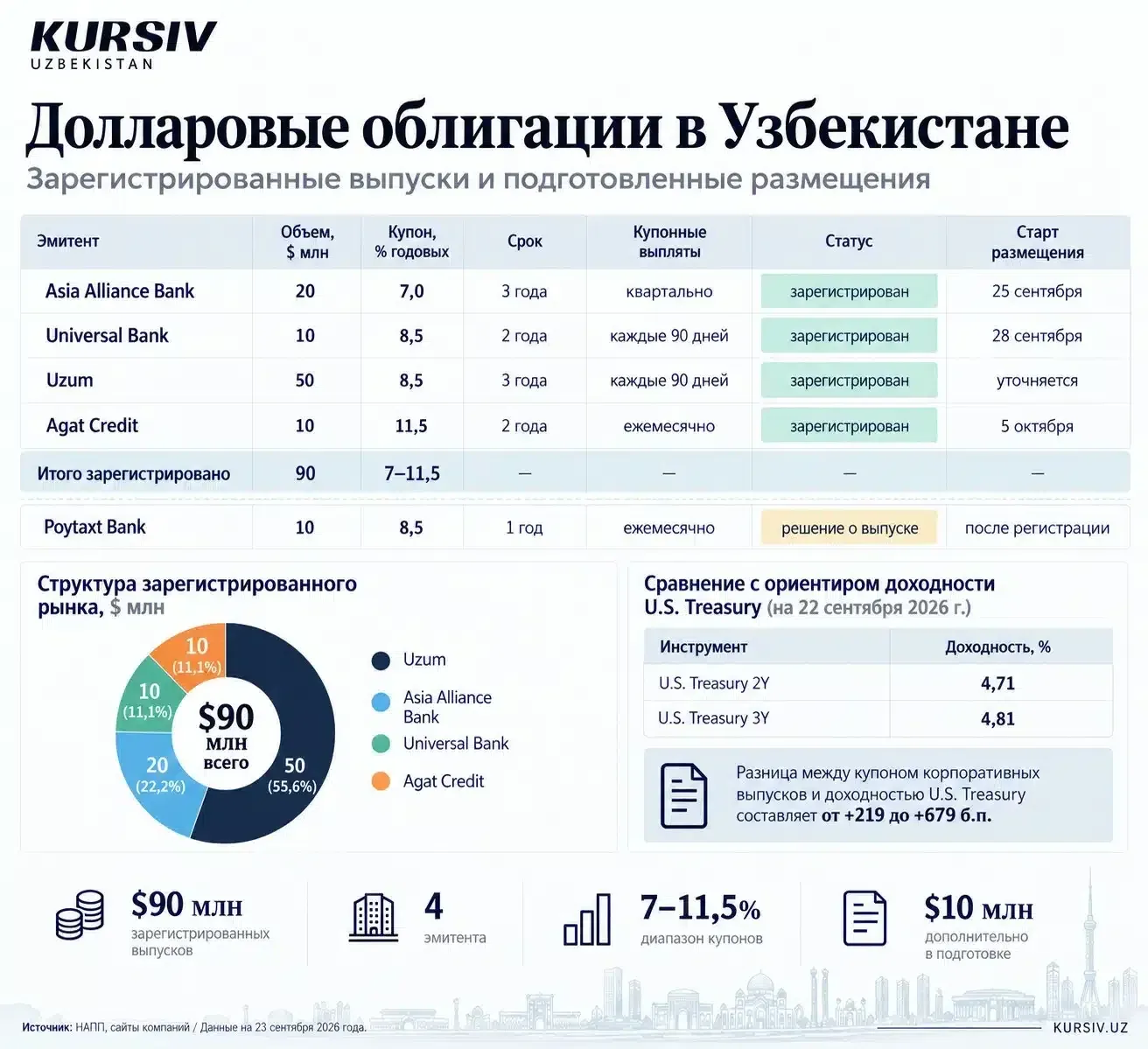
Dollar bonds in Uzbekistan: registered issues and planned placements. Infographic: Kursiv Uzbekistan
The issuer’s strategy: diversification, not a new model
Agat Credit draws a clear line between its business model and its funding instruments. Asked where the $10 million raised will go and whether it plans to issue foreign-currency loans, a company representative stressed:
“The funds raised will be used to expand our loan portfolio and further develop microfinance programmes — primarily for small and micro businesses, individual entrepreneurs and self-employed people across the country. The company’s core business is financing small and micro businesses, including the self-employed and individual entrepreneurs. As for foreign-currency lending: at this stage we do not plan to issue microloans in foreign currency. Our clients operate in sums, and creating foreign-currency liabilities for them would be unwise from a risk management perspective. Raising dollar funding is a way of diversifying our funding base, not a change in our product model.”
The key challenge for any organisation raising foreign currency with sum-denominated revenue is devaluation risk. Agat Credit explained its checks and balances for managing this mismatch in detail:
“We are fully aware of the nature of this risk and approach it in a balanced way. First, the size of this issue is moderate relative to our assets and equity — the company’s regulatory capital adequacy is 22.64% against a minimum requirement of 10%, which provides a significant safety margin. Second, participating in the regulatory sandbox lets us practise managing currency positions in a controlled environment with methodological support from NAPP and the regulator. Protecting margins remains our priority, and we will not take on risks disproportionate to our capital base.”
The company also sees the current issue as an important milestone in its institutional transformation:
“A debut foreign-currency issue in the regulatory sandbox is not just a financial transaction; it demonstrates our operational maturity. The ability to structure and execute a complex instrument with currency risk, work with institutional investors and ensure transparent disclosure are all elements of the management culture that a microfinance bank licence requires. The upcoming issue will be Agat Credit’s sixth bond placement, and each one has steadily strengthened our reputation in the capital market.”
The issuer also rejects concerns that entering the dollar market means abandoning the national currency:
“No, this is about diversification, not substitution. We have consistently and successfully developed sum instruments: the first issue of UZS 40 billion at 29% was placed in March last year, the second of UZS 30 billion (28%) in July, and the third of UZS 40 billion (27%) in November 2025. These instruments enjoyed steady demand, and we do not intend to give them up. The new foreign-currency instrument will be available to both retail and large institutional investors. In this way we are widening our investor base, not narrowing it. Sum debt remains a key element of our funding structure and fully matches the sum nature of our loan portfolio.”
The underwriter’s view: demand structure, pricing and allocation
Freedom is the underwriter of the issue. Zafar Karimov, the company’s CEO in Uzbekistan, explained the financial mechanics of the placement and expectations for the order book in detail.
According to him, the $10 million will not be raised all at once but as funding is actually needed:
“As the underwriter, we expect the full $10 million to be placed. The placement will proceed in stages over one quarter. The issuer will raise funds as it actually needs funding. This practice means the company does not pay a coupon on liquidity that is temporarily not working in the loan portfolio. We see demand from both retail and professional investors. This is largely due to the instrument itself. Bonds with a dollar par value and dollar payments are still rare on the local capital market, and they give investors a chance to add a yielding hard-currency instrument to their portfolio without leaving the domestic market.”
Assessing the structure of potential buyers, Karimov notes that most orders are expected from within the country:
“At this stage the main interest comes from local investors, which is natural. By various estimates, a significant part of household savings has historically been kept in dollars, often outside the financial system. For this audience, an instrument with fixed dollar income and a clear payment structure is a way to put savings to work without taking on currency risk. We expect a demand structure similar to Agat Credit’s previous sum issues. The key participants in those placements were retail investors and, among institutions, local commercial banks. Importantly, the issuer’s bonds did not just sit in portfolios until maturity but were actively traded on the secondary market. For investors, this means the ability to exit a position early at the market price.”
At the same time, participation by foreign non-residents remains in question due to infrastructure and size constraints.
“Non-residents’ interest is preliminary so far. For a foreign investor, this issue competes not with local instruments but with emerging-market dollar paper, including Eurobonds of Uzbek issuers that are available through familiar infrastructure. In addition, the $10 million size and the need to work through local exchange and depository infrastructure limit the range of large international participants. The order book is still being built, so it is premature to talk about specific participation by foreign investors,” the head of the company stresses.
Asked how sum and dollar rates compare, the head of Freedom Broker stresses that the investor’s choice is not about the numbers but about attitude to currency risk:
“A direct comparison of nominal rates is not quite correct. The difference between the yield on sum instruments and 11.5% in dollars essentially reflects the expected weakening of the sum. If the exchange rate stays stable, a sum bond will earn more in dollar terms; if the sum weakens by more than that difference, the dollar instrument wins. Choosing between them is not really about which rate is higher but whether the investor is prepared to take on currency risk. That is why we do not see this issue as a direct competitor to sum bonds. It is aimed at a different audience — investors whose base investment currency is the dollar and who do not want to bet on the exchange rate. For them, the relevant benchmarks are rates on dollar deposits at local banks, which are noticeably lower, and yields on dollar securities in international markets. Against this background, 11.5% looks competitive and reflects the credit risk of a non-bank financial institution.”
As for the placement price and the likelihood of oversubscription, Karimov explained the pricing:
“The order book is still being built, so it is too early to talk about oversubscription. The final placement price will be set in a range of $100.00 to $103.00 based on the orders received and will reflect real investor demand. It is important to understand that the bond’s par value is fixed at $100. A price above par means the investor buys the bond at a premium, but coupon payments and redemption are calculated from par. Priority remains with retail investors. In case of oversubscription, orders will be filled pro rata to their size.”
Zafar Karimov also believes this experience will lay a foundation for the entire financial sector:
“Above all, the Agat Credit placement sets a pricing and structural benchmark for other non-bank credit organisations. A real deal with clear parameters, documentation and order book results noticeably lowers the barrier for the next issuers. It is too early to talk about a mass trend. New issuers’ interest will depend on the yield the market is prepared to accept, the availability of foreign-currency funding from traditional sources and the complexity of regulatory procedures.”
Risk profile and systemic effect
Farrukh Khodjaev, director of the investment company KAP DEPO, suggests looking at the event through the lens of the objective risk-return balance and infrastructure constraints.
Assessing the issue’s potential success and the chances of changes to the underlying legislation, the expert says:
“I think Agat Credit’s first case will be quite successful, primarily because of the novelty of the instrument and the high foreign-currency yield. For a local investor, 11.5% a year in dollars is a very strong offer compared with foreign-currency deposits at banks. But I would not rush to say that one issue will immediately lead to a full change in legislation. Rather, it is a test case for the regulator and the market. If the placement goes well, payments are made without disruption and investors and infrastructure handle foreign-currency settlements properly, it could indeed become an argument for extending foreign-currency bonds beyond the sandbox — primarily for large, transparent and financially sound issuers.”
Khodjaev particularly stresses that a double-digit dollar rate is not an anomaly but fair compensation for the risk of the private MFO sector:
“A yield of 11.5% in dollars looks high, but for an MFO it broadly reflects the real risk profile. You have to understand that this is not a bank deposit. It is the corporate risk of a private microfinance organisation, and in foreign currency. On the one hand, MFOs have high business margins. On the other, the sector has its own risks: portfolio quality, NPLs, regulatory constraints, funding costs and currency risk. So I would put it this way: the rate is attractive for investors, but it is not a gift from the market — it is compensation for higher risk.”
Note that this issue is secured by an insurance policy from Apex Insurance JSC for $12.3 million. Analysing the insurance-based security mechanism, the KAP DEPO director urges investors to double-check its reliability:
“An insurance policy as security is an interesting and useful investor protection tool, but it cannot be seen as a complete substitute for analysing the issuer’s creditworthiness. Investors should look not only at whether there is insurance, but also at the financial strength of the insurer itself, the policy terms, exclusions, the claims procedure and whether there is reinsurance. For our market this is an important step forward, because more sophisticated investor protection structures are appearing. But when default risks of millions of dollars are involved, I would be cautious about a situation where all the risk stays on the local insurance market without international reinsurance. In that case the investor has to assess two risks: the issuer’s and the insurer’s.”
Speaking about a possible outflow of foreign-currency deposits from commercial banks (where dollar deposit rates are around 5–6%), Khodjaev forecasts a selective shift of capital:
“I don’t think we will immediately see a mass shift of foreign-currency deposits from banks into such bonds. For many investors a bank deposit remains a more familiar and understandable instrument. But some more sophisticated investors — especially companies, wealthy individuals and brokerage clients — may well start moving part of their foreign-currency liquidity into such securities. The difference in yield is very noticeable: if banks pay 5–6% on dollar deposits on average and this pays 11.5%, there will inevitably be interest. But it will not replace deposits; rather, it is a new investment class for those prepared to take corporate risk for a higher return. For the banking sector it will be a signal: competition for foreign-currency liquidity will gradually intensify, especially if large and understandable issuers start coming to the market.”
Analysing the fundamental currency mismatch, the expert confirms the risks exist but considers them manageable at the pilot level:
“Yes, there is currency risk here, and it is one of the key ones. An MFO’s business mainly generates income in sums, while the obligations under the issue are fixed in US dollars. If the sum devalues significantly over two years, the issuer’s debt burden in national currency terms will grow. I would not yet call it a systemic risk for the whole market — the issue size is limited and this is a pilot case. But for the issuer itself it is an important risk that must be managed carefully through currency reserves, asset and liability structure, financial planning and stress testing.”
Kursiv Uzbekistan previously reported that the problem of unclaimed dividends in Uzbekistan has almost disappeared.
Source: Kursiv Uzbekistan