How Uzbekistan’s corporate bond market picked up speed
Kursiv Uzbekistan asked experts what is driving the segment’s growth

Photo: depositphotos.com
In the first nine months of 2025, bond trading on the Tashkent Stock Exchange totalled about UZS 663 billion — almost six times more than in the same period of 2024. The market value of bonds on the exchange quotation list reached UZS 1.5 trillion. Kursiv Uzbekistan asked experts what is driving the development of the debt market in the country.
In this article you will learn:
- What bonds are on the market
- The most popular instruments
- The most active investors
- Risks
- Forecast for 2026
- Promising sectors
What is on the market
At the end of September 2025, the exchange quotation list included 19 instruments from 11 companies. The average daily trading volume in the bond market was UZS 3.53 billion, and the average number of trades per day was 39. For comparison, last year the figures were UZS 627 million and 13 trades.
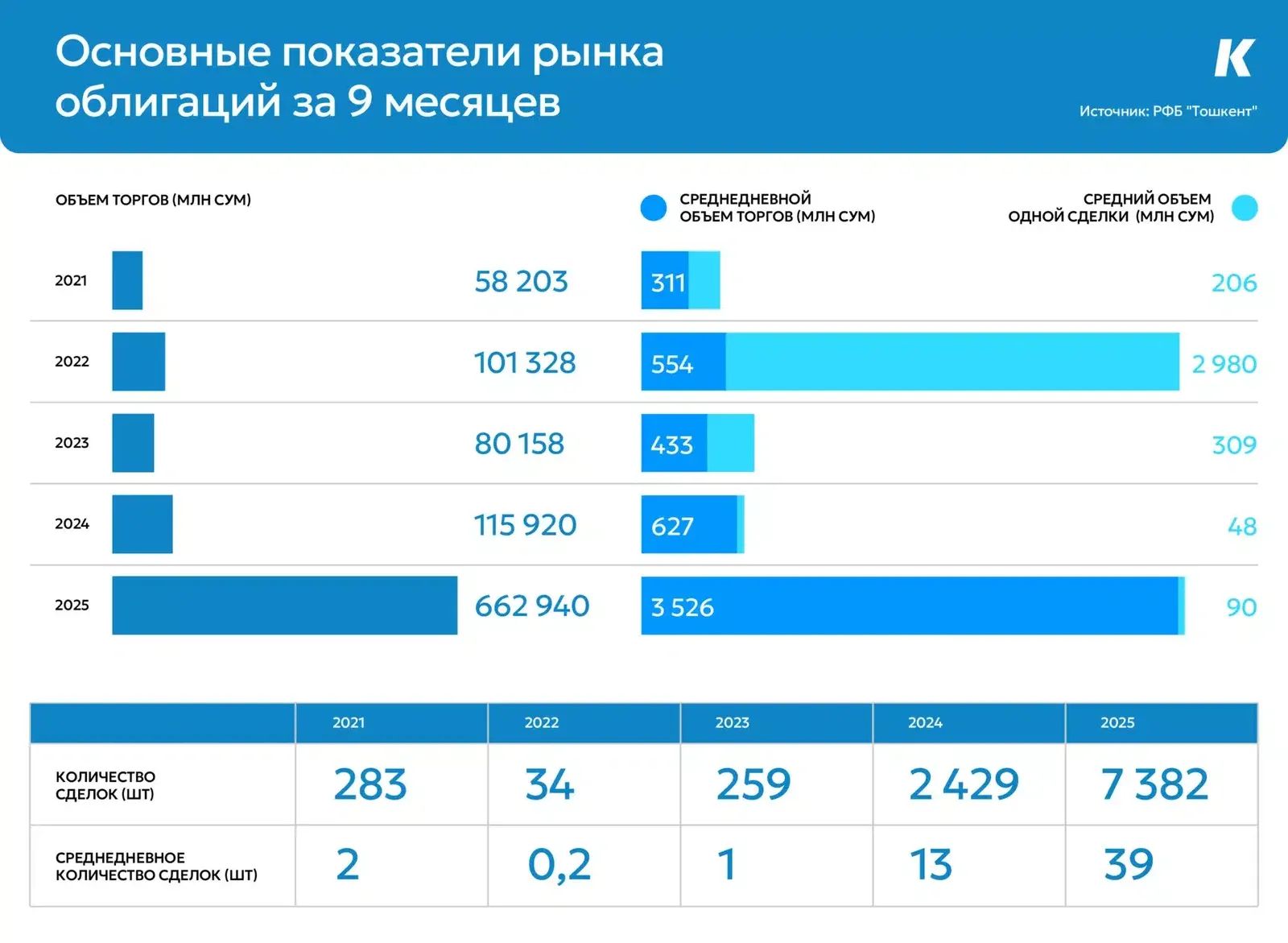
Key bond market indicators for nine months. Source: Tashkent Stock Exchange
Although trading volume grew noticeably in 2025, almost half of the turnover in value terms came from a single issuer — Uzum (about UZS 320 billion). That issue was aimed at institutional investors, as the par value of one bond was UZS 500 million. Retail investors were interested in other issuers’ bonds.
The most popular instruments
Bonds of microfinance organisations (MFOs) were the most actively traded by number of trades in the first nine months of 2025, owing to their high yields and relatively short maturities, explains Farrukh Khodjaev, director of the investment company Kapital Depozit.
Investor interest in these bonds is explained by yields of 27–29% per annum, higher than average bank deposit rates (21–23%).
“It is also important that these issuers already have placement experience and a positive payment history, which increases the trust of private investors and supports steady demand for their bonds,” Khodjaev adds.
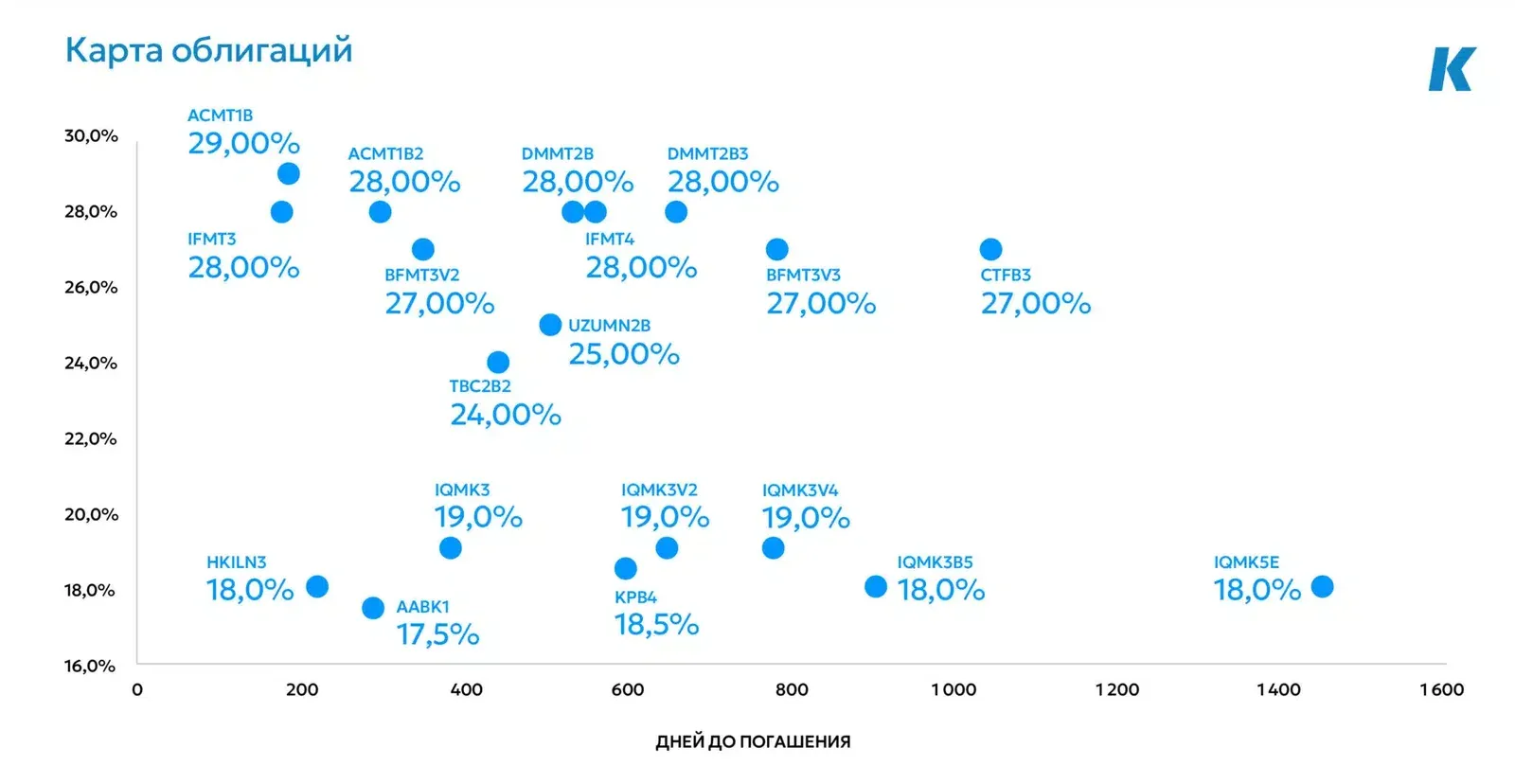
Bond map. Source: Tashkent Stock Exchange
Arnold Vdovkin, an analyst at Avesta Investment Group, describes a similar picture. According to him, over nine months almost 3,900 trades were made in Agat Credit bonds (ticker ACMT1B) and about 1,500 in Biznes Finans Mikromoliya Tashkiloti bonds (BFMT3V2). He says investor interest is explained by a combination of relatively high yields (for example, the coupon on Agat Credit bonds is 29% a year with monthly payments), the issuers’ stable creditworthiness and growing interest among both local retail and foreign investors.
Doniyor Akhmedov, head of brokerage services at Freedom Broker, notes that the greatest demand was for bonds of new issuers placed through open subscription during the year. Over nine months, seven new issues with a par value of UZS 625 billion and four new issuers came to the exchange.
“All the new bond issuers are financial sector organisations. Their issue parameters — offered yield, maturities and debt service structure — proved competitive against alternative instruments, attracting the attention of both retail and professional investors,” comments Akhmedov.
Who the most active investors are
As for the investor structure, according to Farrukh Khodjaev, the core of demand today is commercial banks, as well as legal entities and individuals through brokers. Banks buy bonds to manage liquidity and as an alternative to central bank securities, while companies and individuals see an attractive rate of 27–29% and a “live” market instrument. He adds that foreigners are so far entering selectively into large and transparent names.
“By number of trades the retail segment now leads; by volume — institutions,” concludes Khodjaev. Through the end of the year he expects banks and corporate investors to retain a significant share, retail to grow thanks to mobile apps and brokers’ active marketing, and the share of foreigners may increase as new issues from large, understandable companies appear.
Doniyor Akhmedov also sees high activity among retail investors and the gradual involvement of professional investors. For the retail segment, the key factor is the chance to earn a higher effective yield than with traditional instruments, with a low entry threshold and simple investment mechanics.
As for professional participants, according to Akhmedov, activity came from banks. Their interest grew against the backdrop of excess liquidity, the expansion of the market, and a desire to diversify portfolios and increase yields.
However, Arnold Vdovkin, judging by his company’s clients, notes that foreign investors — both individuals and investment funds — are also showing interest in bonds.
In his view, the insufficient involvement of local retail investors is due to low awareness of available investment products and underdeveloped trading infrastructure. He predicts that the investor structure will remain the same until the end of the year: large players will hold and buy bonds to place spare cash at a fairly high rate, with a small share of retail investors who are only just getting to know the investment process.
What are the risks
Farrukh Khodjaev assesses MFO credit risk as moderate, since all issues meet the requirements for the companies’ capital and financial results. He explains that the high rates on MFO bonds are due to the high profitability of their core business — microloans, which yield on average about 60% a year.
However, the expert highlights several structural problems of the market:
- trading liquidity: a large share of issues is bought by large investors and held to maturity, so secondary market trading remains thin;
- ratings: for all issues, ratings are still a formality, and investors rely on the name and reputation of the issuer and the broker;
- debt structure: the market has few covenants and secured issues; bonds are mostly unsecured.
“I would separately note the issue of asset quality (NPL) in the MFO sector; here the Central Bank, as their regulator, plays a key role,” Khodjaev adds. He stresses that simplifying bond issuance procedures is good for the stock market, but “it automatically raises the bar for analysis and responsibility on the part of investors and professional participants”.
Arnold Vdovkin also emphasises the importance of the share of non-performing loans (NPL) in assessing MFO credit risk. Across all MFOs in the country, the ratio was 4.1% as of 1 October 2025. Most MFO issuers are below the industry average. The exception is Imkon Finans, with a fairly high NPL ratio of 24.6%. For comparison, the ratio is 1.2% at Delta LLC, 0.7% at Biznes Finans and 2.3% at Agat Credit.
Forecast for 2026
“Until the end of 2025 I would give a ‘positive’ forecast,” says Farrukh Khodjaev. He expects demand for bonds to remain high, especially for MFO issues, new placements of which have already started and are expected to sell out as quickly as previous ones. In his view, these issues can be called the market’s locomotives this year.
In early 2026 Khodjaev allows for a slight drop in activity, but MFOs are likely to continue dominating the debt market as long as interest rates on microloans remain high.
Doniyor Akhmedov also believes the market retains positive sentiment despite the seasonal slowdown in trading. He expects steady demand thanks to new placements, as well as growing activity on the secondary market as real yields on corporate bonds take shape.
“Clients show steady interest in new placements, which recently has often led to oversubscription,” comments the expert.
Arnold Vdovkin confirms that demand in the corporate bond market is quite high and continues to grow, especially from foreign investors. Demand is supported by high coupon rates (24–25% a year) and by the fact that interest income on bonds earned by resident and non-resident individuals and companies is exempt from personal income tax and corporate profit tax (Article 483 of the Tax Code).
Promising sectors
The most promising issuers in 2025 remain microfinance organisations, for which bond issuance has become an effective way of raising capital. According to Farrukh Khodjaev, this segment has already proved its ability to offer investors attractive yields with a clear business model.
Khodjaev also highlights:
- fintech companies: the segment is gaining momentum, and Uzum is already holding its second bond placement with a 24% annual coupon. For such companies, debt instruments are becoming a convenient and flexible way of funding;
- strategic energy companies: for example, Hududgaztaminot JSC, which plans to place corporate bonds before the end of 2025. Investors traditionally see the energy sector as stable and systemically important.
Doniyor Akhmedov sees potential in placements by banking sector players.
“State banks are particularly in need of funding given the government’s agenda for implementing investment projects in priority sectors of the economy. The domestic market can partly cover this need,” he explains.
Akhmedov also sees potential among new banks, for which it is harder to attract funds through deposits and compete with other banks; bonds could be an alternative solution. At the same time, it is harder to talk about the real sector because the market’s rate requirements are high relative to the margins of non-financial companies.
Arnold Vdovkin notes that companies engaged in financial activities (MFOs, leasing companies) show the greatest interest in issuing bonds. According to him, they need to diversify their funding sources, and issuing debt securities is an excellent alternative to bank loans.
Vdovkin also names construction companies and food retail as promising areas for bond issuance. In his view, these industries have high investment activity and a need for long-term financing.
Source: Kursiv Uzbekistan